
ISO/IEC 22237 & EN 50600 Data Centre Design Standard

Most “data centre standard” conversations collapse into a single number — a Tier badge or a PUE figure — and miss that the actual design standard is a structured family of documents covering power, cooling, cabling, security, and the metrics that govern all of them.
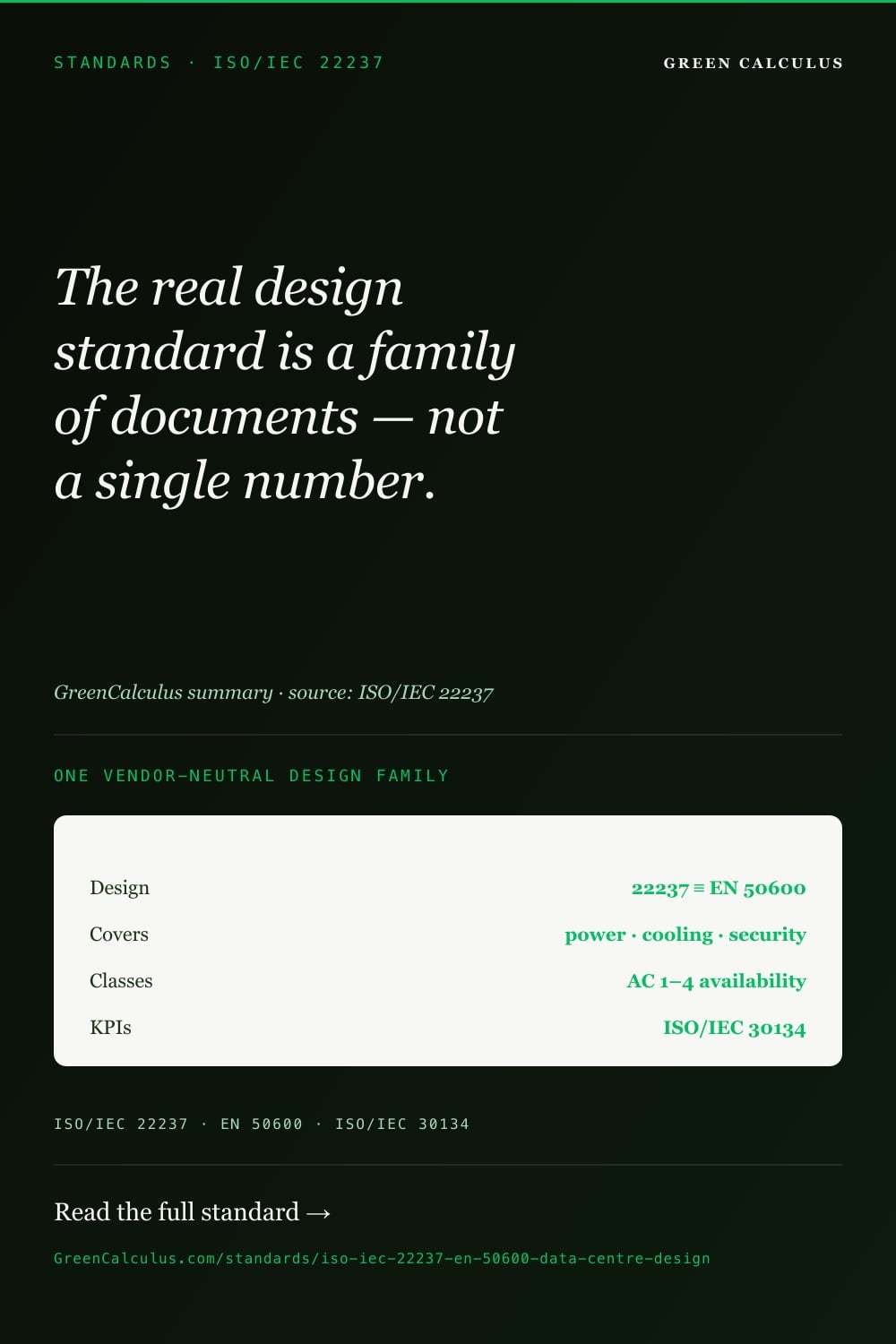
ISO/IEC 22237 and its European parent EN 50600 are that family: a holistic, class-based design framework, paired with the ISO/IEC 30134 KPI series that defines what PUE, CUE, and WUE actually mean.
ISO/IEC 22237 (the international sister to Europe's EN 50600) is the multi-part standard for data centre facilities and infrastructures, covering building, power, cooling, cabling and security across four availability classes.
Executive Summary
The data centre industry uses the word “standard” loosely. The Uptime Institute Tier system is a proprietary rating scheme; ANSI/TIA-942 is a telecommunications-led design standard; ASHRAE supplies thermal guidelines and an energy standard. Sitting across all of them is a formal, internationally governed design standard for data centre facilities and infrastructures: ISO/IEC 22237, the international counterpart to Europe’s EN 50600, paired with the ISO/IEC 30134 series that standardises the efficiency and sustainability KPIs. This trio is the closest thing the sector has to a single, holistic, vendor-neutral design-and-operate framework.
EN 50600 was developed by CENELEC and published in parts from around 2012. ISO/IEC then adopted the EN 50600 content — initially as Technical Specifications, progressively converted into full International Standards — as the ISO/IEC 22237 series under ISO/IEC JTC 1/SC 39. The two are deliberately aligned: ISO/IEC 22237 elevates EN 50600 to an international level so that data centres can be designed, built, and operated to the same principles worldwide. The companion ISO/IEC 30134 KPI series (and its EN 50600-4 European mirror) defines PUE, Renewable Energy Factor, Energy Reuse Factor, Carbon Usage Effectiveness, Water Usage Effectiveness, and the IT-equipment efficiency and utilisation metrics — so that a quoted “PUE” means one specific, audited thing rather than a marketing figure.
(1) The design standard is a family — ISO/IEC 22237 (facilities/infrastructure) plus ISO/IEC 30134 (KPIs) — not a single Tier badge. (2) It is class-based, not pass/fail: four availability classes for power, cooling, and cabling, and four protection classes for physical security, each chosen from a business-risk analysis. (3) Availability Classes are analogous to Uptime Tiers but not identical — the assessment basis differs. (4) The sustainability hooks (PUE, CUE, WUE, ERF) are standardised in ISO/IEC 30134 and increasingly referenced by EU regulation, which is what turns a voluntary design standard into a compliance-relevant one.
Provider directory
Now you need somewhere to keep it.
See who does this work. Every listing names the standards it works to, and paid placements are labelled. Including Terrascope and One Click LCA.
Browse 4 carbon software providers →Do this work? A listing is US$390 a year. Get listed →
What the Standard Is
ISO/IEC 22237, formally Information technology — Data centre facilities and infrastructures, is a multi-part standard that specifies requirements and recommendations for the design, planning, procurement, integration, installation, operation, and maintenance of the physical infrastructure inside a data centre. It addresses the building itself, the power distribution chain, the environmental-control (cooling) systems, the telecommunications cabling, the physical security systems, and the management and operational information needed to run the facility against its defined objectives.
The standard is explicitly holistic. Rather than treating power, cooling, and security as separate disciplines, it organises them under a common framework of availability, physical security, and energy-efficiency objectives, each of which is derived from a business-risk analysis and then expressed as a class. A facility does not “pass” ISO/IEC 22237 in the abstract; it is designed and assessed to a chosen availability class and chosen protection classes, with the efficiency KPIs measured and reported against the ISO/IEC 30134 definitions.
It serves a broad audience by design: owners, operators, facility and ICT managers, and project managers on one side; consultants, architects, building and system designers, auditors, and test-and-commissioning agents on the other. Because it covers the full design-build-operate lifecycle, it is frequently referenced in tenders and procurement — a colocation customer or public buyer can specify “ISO/IEC 22237 Availability Class 3” as a contractual requirement and have it independently verified.
Why It Matters to Sustainability and Compliance Teams
For a long time this standard family was the concern of facilities engineers, not sustainability teams. That has changed as data centre energy and water use moved onto the regulatory agenda. Four pressure points now make it directly relevant to corporate sustainability and compliance work.
EU regulatory reporting. The EU Energy Efficiency Directive introduced a data-centre reporting and rating framework that draws on standardised infrastructure metrics — the ISO/IEC 30134 KPIs are the natural vocabulary for it. Operators reporting energy performance need PUE, and increasingly CUE and WUE, measured to a defensible definition rather than a marketing one.
Scope 2 and the electricity question. A data centre’s overhead — everything that is not the IT load itself — is captured by PUE, and its carbon by CUE. Both feed directly into Scope 2 electricity emissions accounting and the choice of electricity emission factor. A sustainability team reconciling a colocation provider’s reported emissions needs to understand what PUE and CUE do and do not include.
CSRD and energy disclosure. Under CSRD / ESRS E1, energy consumption and energy intensity are reportable, and for digital-infrastructure-heavy businesses the data centre is the dominant line. Standardised KPIs make those disclosures comparable and auditable.
Energy management integration. The standard dovetails with ISO 50001 energy management and the broader ISO management-system family. A facility certified to ISO/IEC 22237 with an ISO 50001 energy-management system in place has a coherent, auditable story from design intent through to continuous energy-performance improvement.
The Standard Family and Publication History
Three related document families are easy to confuse and worth separating cleanly: EN 50600 (the European design standard), ISO/IEC 22237 (its international counterpart), and ISO/IEC 30134 (the KPI series, mirrored in Europe by EN 50600-4).
| Period | Milestone | Status |
|---|---|---|
| From ~2012 | EN 50600 series published in parts by CENELEC — the European data centre design standard, in use across Europe from around 2015 | European reference; basis for ISO/IEC 22237 |
| 2016–2018 | EN 50600-4 KPI parts and ISO/IEC 30134 KPI series published (general concepts, PUE, REF, ITEEsv, ITEUsv) | KPI definitions established |
| 2018 | ISO/IEC adopts EN 50600 content as the ISO/IEC TS 22237 Technical Specifications (Parts 1–7), initially direct copies of the EN 50600 documents | Technical Specification stage |
| 2020–2023 | Further ISO/IEC 30134 KPIs published — Energy Reuse Factor (Part 6), Cooling Efficiency Ratio (Part 7), Carbon Usage Effectiveness (Part 8), Water Usage Effectiveness (Part 9) | KPI series substantially complete |
| 2021 onward | ISO/IEC 22237 Parts 1, 2, 3, 4, and 6 published as full International Standards; Parts 5 and 7 remain as Technical Specifications pending conversion | Operative — partial IS, partial TS |
| 2026 | ISO/IEC 30134-2 (PUE) revised — adds guidance for mixed-use buildings, updated measurement requirements, and clearer treatment of unaccounted energy and on-site generation | Latest substantive KPI update |
EN 50600 is maintained by CENELEC (the European Committee for Electrotechnical Standardization). ISO/IEC 22237 and ISO/IEC 30134 are maintained by ISO/IEC JTC 1/SC 39, the joint subcommittee for sustainability, IT, and data centres. The content is deliberately kept aligned, so EN 50600-4 and ISO/IEC 30134 KPI definitions are, in practice, near-identical. Where this page cites a part number, it gives the ISO/IEC reference; the EN 50600 equivalent carries the same scope.
The ISO/IEC 22237 Part Structure
The standard is organised into seven parts, each covering one infrastructure discipline. Part 1 sets the general concepts — including the availability and protection class framework — that the discipline-specific parts then apply.
| Part | Title | Scope |
|---|---|---|
| Part 1 | General concepts | The framework — availability classes, protection classes, energy-efficiency objectives, and how the discipline-specific parts relate |
| Part 2 | Building construction | The building shell, location, structure, and construction requirements for the facility |
| Part 3 | Power distribution | The electrical supply and distribution chain, redundancy topology, and protection |
| Part 4 | Environmental control | Cooling and environmental conditioning — the systems that keep IT equipment within its operating envelope |
| Part 5 | Telecommunications cabling infrastructure | The structured cabling that carries data within the facility (Technical Specification at publish) |
| Part 6 | Security systems | Physical security — access control, intrusion, fire, and environmental-hazard protection |
| Part 7 | Management and operational information | The operational data and management processes needed to monitor performance against objectives (Technical Specification at publish) |
The split matters in practice because availability is assessed per infrastructure. A facility’s power distribution, environmental control, and cabling can each carry a different availability class — a site might be Availability Class 3 for power but Class 2 for cooling, depending on how it was designed and where the business risk was judged to lie. There is no single facility-wide “Class” number that overrides the per-infrastructure assessment.
Availability Classes (AC 1–4)
The availability framework is the backbone of the design standard. Each of the relevant infrastructures — power distribution, environmental control, and telecommunications cabling — is assigned one of four availability classes, chosen from a business-risk analysis. The classes escalate from single-path, single-component up to fault-tolerant.
| Class | Name | Capacity components | Distribution paths |
|---|---|---|---|
| AC 1 | Basic site infrastructure | Single capacity components | A single, non-redundant distribution path serving the ICT equipment |
| AC 2 | Redundant capacity component site infrastructure | Redundant capacity components | A single, non-redundant distribution path |
| AC 3 | Concurrently maintainable site infrastructure | Redundant capacity components | Multiple independent distribution paths (one may serve the load while the other is on standby) — any element can be maintained without taking the load down |
| AC 4 | Fault-tolerant site infrastructure | Redundant capacity components | Multiple independent and active distribution paths — the infrastructure tolerates a fault without interrupting the ICT load |
The escalation logic is two-dimensional: AC 1 → AC 2 adds redundant capacity components; AC 2 → AC 3 adds independent distribution paths so maintenance can occur without downtime (concurrent maintainability); AC 3 → AC 4 makes those paths active and fault-tolerant so a failure does not interrupt service. Higher classes cost more in capital, consume more in standby and conversion losses, and therefore carry a real sustainability trade-off — over-specifying availability is also over-specifying energy and embodied carbon.
The standard ties the class to a business-risk analysis precisely because higher is not automatically better. A redundant, fault-tolerant facility runs more infrastructure at part load, which depresses efficiency (a higher PUE) and raises embodied carbon. The right class is the lowest one that meets the genuine availability requirement of the workloads — the same materiality logic that governs resilience spending elsewhere in infrastructure.
Availability Class vs Uptime Tier vs TIA-942
The single most common confusion in data centre procurement is treating ISO/IEC 22237 Availability Classes, Uptime Institute Tiers, and ANSI/TIA-942 Ratings as interchangeable. They map roughly onto the same four-level resilience ladder, but they are governed differently, assessed differently, and are analogous, not equivalent.
| Resilience level | ISO/IEC 22237 / EN 50600 | Uptime Institute | ANSI/TIA-942 |
|---|---|---|---|
| Basic | Availability Class 1 | Tier I | Rated-1 |
| Redundant components | Availability Class 2 | Tier II | Rated-2 |
| Concurrently maintainable | Availability Class 3 | Tier III | Rated-3 |
| Fault tolerant | Availability Class 4 | Tier IV | Rated-4 |
The differences that matter:
- Assessment basis. ISO/IEC 22237 / EN 50600 assesses design architecture through planning, documentation, and infrastructure concept, within a holistic framework that also covers energy efficiency, security, and operations. The Uptime Tier system focuses on specifically verifiable fault tolerance and is a de-facto commercial standard, particularly in North America and Asia, with thousands of certificates issued worldwide.
- Governance. ISO/IEC 22237 and EN 50600 are formal, committee-governed standards (ISO/IEC JTC 1/SC 39; CENELEC). The Uptime Tier system is a proprietary scheme operated by a single body. TIA-942 is a telecommunications-industry standard.
- Uptime percentages. The Uptime Tier system is sometimes quoted with specific availability percentages (for example, Tier III at roughly 99.982% and Tier IV at roughly 99.995% annual availability). These figures belong to the Uptime framework and should not be assumed to attach identically to an ISO/IEC 22237 Availability Class — the standards do not define equivalence at that level of precision.
A facility certified Uptime Tier III is not automatically ISO/IEC 22237 Availability Class 3, and vice versa. The crosswalk above is a conceptual map for understanding, not a certification equivalence. A procurement specification that requires one cannot be satisfied by a certificate in another without a separate assessment.
Protection Classes
Alongside availability, the standard defines a parallel framework of physical-security protection classes. Each data centre space — regardless of size or purpose — is designated to one of four protection classes, and the required class is identified separately for each physical-security objective.
| Protection objective | Against |
|---|---|
| Unauthorised access | People entering spaces they are not permitted to enter (at least three protection classes must be available for this objective) |
| Intrusion | Forced or covert physical intrusion into the facility |
| Fire | Detection, suppression, and containment of fire |
| Internal and external environmental hazards | Flood, extreme weather, and other environmental threats to continuity |
As with availability, protection classes are chosen from a risk analysis rather than maximised by default — and they are space-specific, so a meet-me room, a data hall, and a plant room can carry different protection classes within the same facility. The four-class structure means a buyer can specify, and a certifier can verify, a precise physical-security posture rather than a vague “secure” assertion.
Power Distribution (Part 3)
Part 3 governs the electrical supply and distribution chain — from the utility intake through transformation, uninterruptible power supply, generation backup, and distribution to the ICT load. The availability class is expressed here through the redundancy of capacity components (transformers, UPS, generators) and the independence of distribution paths.
The power chain is where the availability/efficiency trade-off is sharpest. Redundant UPS and conversion stages held at part load to provide concurrent maintainability or fault tolerance carry conversion and standby losses, which show up directly in PUE. The standard also recognises the interaction between data centres and the wider grid — on-site energy storage and energy export change the resource-metric picture, and the KPI definitions account for how stored and exported energy is treated. A facility offering demand-response or exporting energy is not simply a load; its reported efficiency metrics have to handle those flows correctly.
Environmental Control (Part 4)
Part 4 covers the cooling and environmental-conditioning systems that keep IT equipment within its operating envelope. Cooling is typically the largest single component of data-centre overhead — the dominant driver of PUE above 1.0 — so it is the primary lever for both efficiency and water use.
The standard’s environmental-control requirements sit alongside the widely used ASHRAE thermal guidelines, which define recommended and allowable temperature and humidity envelopes for IT equipment. Designing to the wider end of the allowable envelope enables free-cooling (economiser) operation for more hours of the year, cutting energy use — but can increase water consumption where evaporative cooling is used, which is the tension that the Water Usage Effectiveness KPI (see §14) exists to expose. The arrival of high-density AI compute is pushing environmental control toward liquid cooling, which changes the efficiency and water calculus again and is an active area of standards development.
Cabling, Security, and Management (Parts 5–7)
Part 5 — Telecommunications cabling infrastructure
Part 5 specifies the structured cabling that carries data within the facility, aligned to the broader generic-cabling standards but adapted to the data-centre environment and its availability classes. At publish it remains a Technical Specification pending conversion to a full International Standard.
Part 6 — Security systems
Part 6 details the physical-security systems that implement the protection classes from Part 1 — access control, intrusion detection, fire detection and suppression, and environmental-hazard protection. It is one of the parts published as a full International Standard.
Part 7 — Management and operational information
Part 7 addresses the operational data and management processes needed to monitor a facility against its defined availability, security, and efficiency objectives. This is the part that connects the physical design to ongoing operation and to the KPI measurement that feeds regulatory reporting. At publish it remains a Technical Specification.
The Efficiency and Sustainability KPIs — ISO/IEC 30134
The ISO/IEC 30134 series is where the sustainability substance of the data-centre standard family lives. It defines the key performance indicators that quantify a facility’s energy efficiency, renewable and reuse performance, carbon, and water — each with a standardised calculation method so that a reported figure means one specific, comparable thing.
| KPI | ISO/IEC 30134 part | What it measures |
|---|---|---|
| PUE — Power Usage Effectiveness | Part 2 | Total facility energy ÷ IT equipment energy. The headline efficiency metric. |
| REF — Renewable Energy Factor | Part 3 | Share of the data centre’s energy that comes from renewable sources. |
| ITEEsv — IT Equipment Energy Efficiency for servers | Part 4 | Energy efficiency of the server equipment itself. |
| ITEUsv — IT Equipment Utilization for servers | Part 5 | How fully the server equipment is utilised (idle capacity is wasted energy). |
| ERF — Energy Reuse Factor | Part 6 | Energy reused (e.g. recovered heat) ÷ total energy consumed. |
| CER — Cooling Efficiency Ratio | Part 7 | Efficiency of the cooling system specifically. |
| CUE — Carbon Usage Effectiveness | Part 8 | Carbon emissions associated with the data centre’s energy per unit of IT energy. |
| WUE — Water Usage Effectiveness | Part 9 | Water consumed per unit of IT energy. |
PUE is widely quoted and frequently misused. The only genuine PUE is the one defined in ISO/IEC 30134-2 (mirrored by EN 50600-4-2). A figure produced by a non-standard boundary, a partial measurement period, or a design estimate dressed up as a measured result is not standardised PUE. When a provider quotes a PUE, the questions that matter are: measured or design? over what period? to which boundary? and to which edition of the standard? The 2026 revision of ISO/IEC 30134-2 specifically tightened the treatment of mixed-use buildings, unaccounted energy, and on-site generation — exactly the areas where non-standard PUE figures tend to flatter.
PUE in Depth
PUE is the ratio of total facility energy to IT equipment energy:
PUE = total facility energy ÷ IT equipment energy
A theoretically perfect facility, where every unit of energy reached the IT load and nothing was lost to cooling, power conversion, or lighting, would have a PUE of 1.0. Real facilities sit above that: the excess over 1.0 is the overhead — predominantly cooling, then power-conversion losses, then ancillary loads. A PUE of 1.5 means that for every unit of energy doing useful IT work, half a unit again is consumed by overhead.
A facility draws 1,500 kW total, of which the IT load is 1,000 kW.
PUE = 1,500 ÷ 1,000 = 1.50. The overhead is 500 kW, or 50% on top of the IT load.
Carbon link: the total facility draw — not just the IT load — is what multiplies by the grid emission factor to give the facility’s Scope 2 electricity emissions. Improving PUE from 1.50 to 1.30 on the same IT load cuts total draw from 1,500 kW to 1,300 kW, a ~13% reduction in electricity and the associated Scope 2 emissions, with no change to the useful computing delivered.
(Illustrative figures for the calculation chain — not a measured value for any specific facility.)
PUE’s limits are as important as its definition. It measures infrastructure overhead, not useful work: a facility full of idle servers can post an excellent PUE while wasting energy, which is why ITEUsv (utilisation) is a necessary companion metric. It says nothing about the carbon intensity of the electricity (that is CUE) or about water (WUE). And it is sensitive to measurement boundary and period — an annualised, measured PUE to the ISO/IEC 30134-2 boundary is a very different number from a design-day estimate. Treat any single PUE figure as one facet of a multi-KPI picture, not a verdict.
Carbon (CUE) and Water (WUE) Effectiveness
PUE answers “how efficiently does this facility use energy?” but not “how clean is that energy?” or “how much water does it cost?” The two newer KPIs close those gaps.
Carbon Usage Effectiveness (CUE), defined in ISO/IEC 30134-8, expresses the carbon emissions associated with the data centre’s energy relative to its IT energy. Where PUE multiplied by the grid emission factor gives the carbon picture implicitly, CUE makes it an explicit, reportable KPI. A facility can have a strong PUE and a poor CUE if it sits on a carbon-intensive grid — which is exactly why location and Scope 2 electricity methodology, including the choice between location-based and market-based accounting, matter as much as physical efficiency.
Water Usage Effectiveness (WUE), defined in ISO/IEC 30134-9, expresses water consumed per unit of IT energy. Water became a first-order data-centre issue as evaporative and adiabatic cooling traded electricity for water in hot, often water-stressed, locations. WUE exposes the trade-off that a PUE-only view hides: a design that improves PUE by leaning on evaporative cooling can worsen WUE substantially. For facilities in water-scarce regions, WUE is increasingly the binding sustainability constraint, not energy.
A defensible data-centre sustainability claim needs at least PUE (energy overhead), CUE (carbon of that energy), and WUE (water cost) together — plus a utilisation metric to confirm the IT load is doing real work. Any one in isolation can be optimised at another’s expense. This is the data-centre analogue of the multi-criteria principle: a single efficiency number can mask a trade-off elsewhere.
Energy Reuse (ERF) and Heat Recovery
The Energy Reuse Factor (ERF), defined in ISO/IEC 30134-6, is the ratio of energy reused to total energy consumed in the data centre. It captures the recovery and productive reuse of energy that would otherwise be rejected as waste heat — most prominently, supplying recovered heat to a district-heating network or to neighbouring buildings.
Heat recovery is the most structurally interesting frontier in data-centre sustainability because it reframes the facility from a pure consumer into a node in a wider energy system. A data centre rejects large quantities of low-grade heat; where that heat can be captured and delivered to a heat network, the ERF rises and the net system-level efficiency improves even if the facility’s own PUE is unchanged. Note the important interaction: PUE and ERF measure different things and can move independently — a facility can have an unremarkable PUE and still deliver substantial value through a high ERF. Reporting both is what tells the full story.
Conformity and Certification
Conformity to ISO/IEC 22237 (and EN 50600) is demonstrated through independent assessment, and there are two distinct routes that practitioners frequently conflate.
| Route | What is assessed | Typical validity |
|---|---|---|
| Design certification | Review of the data centre’s design documents for conformity to the design criteria of the standard at the chosen class — confirms the design intends to meet the requirements | Often around one year (extendable while the site is pre-operational) |
| Facility / site certification | Physical on-site inspection of the built facility against the standard, in addition to a design-document review — confirms the facility as built conforms | Often around three years, with interim surveillance audits |
The distinction is consequential in procurement: a design certificate confirms intent, not delivery. A buyer specifying ISO/IEC 22237 conformity should be clear whether a design or a facility certificate is required — a design certificate on a facility that was then built differently does not demonstrate operational conformity. Certification is performed by accredited certification bodies; several offer combined assessment against TSI (Trusted Site Infrastructure), EN 50600, and ISO/IEC 22237 in a single engagement.
The standard also complements the ISO management-system family rather than competing with it. ISO/IEC 22237 addresses the quality and availability of the physical infrastructure; ISO 50001 addresses the energy-management system that drives continuous efficiency improvement; ISO/IEC 27001 addresses information security; and organisation-level GHG quantification under ISO 14064-1 sits above all of them. A mature operator runs these together — infrastructure conformity, energy management, security management, and carbon accounting as one coherent assurance stack.
Interaction with EU Regulation
The standard family’s regulatory weight comes chiefly from the EU. The recast Energy Efficiency Directive introduced obligations around data-centre energy and sustainability reporting, and a Union-level scheme for rating and disclosing data-centre sustainability indicators. The ISO/IEC 30134 KPIs are the natural metric vocabulary for that reporting — PUE, REF, ERF, CUE, and WUE are exactly the indicators a rating scheme needs, defined to a common, auditable method.
Two consequences follow for corporate teams. First, operators in scope of the EED data-centre provisions need their KPIs measured to the standardised definitions, not to marketing conventions — a non-standard PUE will not survive a reporting obligation that references the standardised metric. Second, the energy and intensity datapoints these metrics feed flow upward into broader disclosure under CSRD / ESRS E1, and the electricity totals feed Scope 2 accounting via the relevant grid emission factors. The design standard, the KPI series, and the disclosure regime form a connected chain from facility design to corporate climate reporting.
Interaction with Other Standards
ISO/IEC 22237 coexists with several other data-centre standards rather than replacing them. Understanding the division of labour prevents both duplicated effort and incorrect substitution.
| Standard / scheme | Focus | Relationship to ISO/IEC 22237 |
|---|---|---|
| EN 50600 | European data centre design standard | The direct parent — same content, regional governance; ISO/IEC 22237 internationalises it |
| ISO/IEC 30134 (EN 50600-4) | Efficiency and sustainability KPIs | The companion KPI series — provides the metrics ISO/IEC 22237 facilities report |
| ANSI/TIA-942 | Telecommunications-led data centre design and rating | Overlapping scope, different lineage; addresses cabling and a four-level Rated system |
| ASHRAE 90.4 / thermal guidelines | Energy standard and thermal envelopes | Complementary — supplies the temperature/humidity envelopes the environmental-control design works to |
| Uptime Institute Tiers | Proprietary resilience rating | Analogous four-level resilience ladder; not an equivalence (see §7) |
| ISO 50001 / ISO/IEC 27001 / ISO 14064-1 | Energy, security, and GHG management | Management-system and accounting layers that wrap around the infrastructure conformity |
The recurring trap is treating the resilience schemes (ISO/IEC 22237 AC, Uptime Tier, TIA-942 Rated) as one thing and the KPI/management standards as optional extras. In a mature programme they are layered: a resilience class for the infrastructure, the ISO/IEC 30134 KPIs for efficiency and sustainability, and the ISO management systems for ongoing assurance.
Common Misinterpretations
The availability classes are analogous to Tiers but assessed and governed differently, and ISO/IEC 22237 is far broader — it covers building, power, cooling, cabling, security, and management, not just resilience. A Tier certificate is not an ISO/IEC 22237 certificate.
Availability is assessed per infrastructure — power, cooling, and cabling can each carry a different class. There is no single overriding facility-wide class number.
Higher classes add redundant infrastructure that runs at part load, raising both PUE and embodied carbon. The standard ties the class to a business-risk analysis; the right class is the lowest that meets the genuine requirement.
Only the ISO/IEC 30134-2 definition is standardised PUE. A figure from a non-standard boundary, a short measurement window, or a design estimate is not comparable to a measured, annualised, standard-boundary PUE.
PUE measures overhead, not carbon or water or useful work. A facility can have an excellent PUE while running on a dirty grid (poor CUE), consuming large volumes of water (poor WUE), or hosting idle servers (poor utilisation). Sustainability needs PUE, CUE, WUE, and utilisation together.
Design certification confirms the design intends to meet the standard; only facility/site certification, with physical inspection of the built site, confirms as-built conformity. The two are not interchangeable in procurement.
Common Implementation and Reporting Errors
- Quoting design PUE as measured PUE. A design-stage estimate is not an operational, measured, annualised figure. State explicitly which you are reporting, the boundary, and the period.
- Reporting PUE without a utilisation metric. A strong PUE on a fleet of idle servers hides wasted energy. Pair PUE with ITEUsv (or an equivalent utilisation measure).
- Treating availability class as facility-wide. Assess and report power, cooling, and cabling classes separately; do not collapse them into one number.
- Cross-walking certifications. Asserting Uptime Tier III “equals” Availability Class 3 in a contract or disclosure. They are analogous, not equivalent; each requires its own assessment.
- Optimising PUE at the expense of water. Leaning on evaporative cooling to cut PUE can worsen WUE materially, especially in water-stressed regions. Report and manage both.
- Ignoring CUE on a clean-PUE facility. A physically efficient facility on a carbon-intensive grid still has high emissions. Carbon depends on the grid factor and the Scope 2 method, not just on PUE.
- Citing a superseded KPI edition. The ISO/IEC 30134-2 PUE definition was revised in 2026; figures computed to an older boundary may not be comparable. Cite the edition.
Implementation Workflow
- Run the business-risk analysis. Determine the genuine availability requirement of the workloads and the physical-security threats — these drive the class selection, not a default “go high”.
- Select availability classes per infrastructure. Choose AC 1–4 separately for power distribution, environmental control, and cabling.
- Select protection classes per objective and space. Assign protection classes for unauthorised access (at least three available), intrusion, fire, and environmental hazards.
- Design to the part requirements. Apply Parts 2–6 (building, power, environmental control, cabling, security) to the chosen classes.
- Instrument for the KPIs. Put metering in place to compute PUE, REF, ERF, CER, CUE, WUE, and utilisation to the ISO/IEC 30134 definitions — measured, not estimated.
- Certify the design, then the facility. Design certification before build; facility/site certification after build, with surveillance audits.
- Wrap with management systems. Run ISO 50001 (energy), ISO/IEC 27001 (security), and organisation-level GHG accounting around the infrastructure.
- Report to the regulatory chain. Feed the standardised KPIs into EED data-centre reporting and the energy/Scope 2 datapoints into CSRD/ESRS disclosure.
Future Evolution
TS-to-IS conversion. The remaining ISO/IEC 22237 parts held as Technical Specifications (notably cabling and management/operational information) are on a path to becoming full International Standards. Practitioners should expect the published-IS coverage to broaden over the next standards cycles, with implementation lead times of a couple of years.
AI density and liquid cooling. The shift to high-density AI compute is straining the air-cooling assumptions behind much existing environmental-control design. Liquid cooling changes the efficiency and water calculus and is driving active development across the environmental-control and KPI parts of the family.
Tightening EU regulation. The EU’s data-centre reporting and rating framework under the Energy Efficiency Directive is expected to sharpen over the late 2020s, raising the stakes on standardised, audited KPIs and on water reporting in particular. The direction of travel — mandatory, comparable, standardised metrics — is firmly set.
New efficiency KPIs. Beyond the established ISO/IEC 30134 set, work continues on metrics that capture useful-work efficiency more directly — server energy effectiveness and application-platform energy effectiveness among them — reflecting the recognition that infrastructure-overhead metrics like PUE do not, on their own, measure whether compute is being delivered efficiently.
Frequently Asked Questions
It is the formal, multi-part design standard for data centre facilities and infrastructures — covering building construction, power distribution, environmental control, telecommunications cabling, security systems, and management information. EN 50600 is the European standard (CENELEC); ISO/IEC 22237 is its international counterpart (ISO/IEC JTC 1/SC 39). The companion ISO/IEC 30134 series defines the sustainability KPIs (PUE, CUE, WUE, ERF, and others). Together they form the closest thing the industry has to a single holistic, vendor-neutral design-and-operate framework.
No standard of that name exists. The Sustainable Digital Infrastructure Alliance (SDIA) was a nonprofit network that published a Roadmap to Sustainable Digital Infrastructure and a Data Center Sustainability Integration Model, and worked on carbon-accounting methodology and a cloud sustainability certification — but not a formal data centre design standard. The recognised data centre design standards are ISO/IEC 22237 / EN 50600 (with ISO/IEC 30134 for KPIs), ANSI/TIA-942, and ASHRAE 90.4. SDIA itself transitioned into an independent consultancy from 2025.
EN 50600 is the European standard, developed by CENELEC and in use from around 2015. ISO/IEC 22237 is the international “sister” standard, which adopted the EN 50600 content — initially as Technical Specifications, progressively converted to full International Standards — to make the same design principles applicable worldwide. The content is deliberately aligned; many requirements are identical, though some details differ. A facility can be assessed against EN 50600 and ISO/IEC 22237 (and the TSI scheme) in a single engagement.
Availability Class 1 is basic site infrastructure — single capacity components and a single non-redundant distribution path. Class 2 adds redundant capacity components but keeps a single distribution path. Class 3 is concurrently maintainable — multiple independent distribution paths so any element can be maintained without taking down the IT load. Class 4 is fault-tolerant — multiple active independent paths that tolerate a fault without interrupting service. Each infrastructure (power, cooling, cabling) is assessed separately, and the class is chosen from a business-risk analysis.
They map onto the same four-level resilience ladder — Availability Class 1–4 are analogous to Uptime Tier I–IV and to ANSI/TIA-942 Rated-1 to Rated-4 — but they are not equivalent. ISO/IEC 22237 assesses design architecture within a holistic framework that also covers efficiency, security, and operations; the Uptime Tier system is a proprietary scheme focused on verifiable fault tolerance. A certificate in one does not automatically satisfy a requirement for another; each needs its own assessment.
Power Usage Effectiveness (PUE) is the ratio of total facility energy to IT equipment energy. A perfect facility would be 1.0; real facilities sit above that, with the excess representing cooling, power-conversion, and ancillary overhead. The genuine, standardised PUE is defined in ISO/IEC 30134-2 (mirrored by EN 50600-4-2) — a figure produced by a non-standard boundary, a partial period, or a design estimate is not standardised PUE. The 2026 revision tightened the treatment of mixed-use buildings, unaccounted energy, and on-site generation.
Carbon Usage Effectiveness (CUE, ISO/IEC 30134-8) expresses the carbon emissions associated with the data centre’s energy relative to its IT energy — it makes the carbon picture an explicit KPI rather than something implied by PUE and the grid factor. Water Usage Effectiveness (WUE, ISO/IEC 30134-9) expresses water consumed per unit of IT energy, exposing the trade-off where evaporative cooling improves PUE but worsens water use. A credible sustainability profile reports PUE, CUE, and WUE together, plus a utilisation metric.
The Energy Reuse Factor (ERF, ISO/IEC 30134-6) is the ratio of energy reused to total energy consumed in the data centre. It captures recovered waste heat that is put to productive use — most prominently, supplying heat to a district-heating network or neighbouring buildings. ERF and PUE measure different things and can move independently: a facility can have an unremarkable PUE and still deliver substantial system-level value through a high ERF, which is why both should be reported.
Design certification reviews the data centre’s design documents for conformity to the standard at the chosen class — it confirms intent, and is typically valid for around a year while a site is pre-operational. Facility (or site) certification adds a physical on-site inspection of the built facility, confirming as-built conformity, and is typically valid for around three years with interim surveillance audits. In procurement, a design certificate does not prove the facility was built and operates to the standard; specify which you require.
The EU Energy Efficiency Directive introduced data-centre energy and sustainability reporting and a Union rating scheme, and the ISO/IEC 30134 KPIs (PUE, REF, ERF, CUE, WUE) are the natural standardised vocabulary for it. Operators in scope need their KPIs measured to the standardised definitions, not marketing conventions. The resulting energy and intensity datapoints flow upward into CSRD / ESRS E1 disclosure, and the electricity totals feed Scope 2 emissions accounting via grid emission factors.
Not on its own. PUE measures infrastructure overhead, not carbon, water, or useful work. A facility can post an excellent PUE while running on a carbon-intensive grid (poor CUE), consuming large volumes of water through evaporative cooling (poor WUE), or hosting idle servers (poor utilisation). A genuine sustainability assessment needs PUE, CUE, WUE, and a utilisation metric together — a single efficiency number can mask a trade-off elsewhere.
At this page’s review date, Parts 1 (general concepts), 2 (building construction), 3 (power distribution), 4 (environmental control), and 6 (security systems) are published as full International Standards. Parts 5 (telecommunications cabling) and 7 (management and operational information) remain Technical Specifications pending conversion. The EN 50600 equivalents carry the same scope. Check the ISO and CENELEC catalogues for the current publication status before citing a specific part edition.
Sources and References
Every methodological statement on this page reconciles to the primary sources below. Figures and part references are hardcoded against the dated primary sources.
Primary standards
- ISO/IEC 22237 series, Information technology — Data centre facilities and infrastructures, Parts 1–7 (ISO/IEC JTC 1/SC 39). Part 1 General concepts; Part 2 Building construction; Part 3 Power distribution; Part 4 Environmental control; Part 5 Telecommunications cabling infrastructure; Part 6 Security systems; Part 7 Management and operational information.
- EN 50600 series, Information technology — Data centre facilities and infrastructures (CENELEC), the European counterpart from which ISO/IEC 22237 derives, including the EN 50600-4 KPI sub-parts.
- ISO/IEC 30134 series, Information technology — Data centres — Key performance indicators: Part 2 Power Usage Effectiveness (PUE); Part 3 Renewable Energy Factor (REF); Part 4 IT Equipment Energy Efficiency for servers (ITEEsv); Part 5 IT Equipment Utilization for servers (ITEUsv); Part 6 Energy Reuse Factor (ERF); Part 7 Cooling Efficiency Ratio (CER); Part 8 Carbon Usage Effectiveness (CUE); Part 9 Water Usage Effectiveness (WUE). ISO/IEC 30134-2 revised 2026.
Related standards and schemes
- ANSI/TIA-942, Telecommunications Infrastructure Standard for Data Centers (Rated-1 to Rated-4).
- ASHRAE Standard 90.4, Energy Standard for Data Centers, and ASHRAE thermal guidelines for data processing environments.
- Uptime Institute Tier Classification System (Tier I–IV) — proprietary resilience rating.
- ISO 50001 (energy management), ISO/IEC 27001 (information security), ISO 14064-1 (organisation-level GHG quantification).
- Trusted Site Infrastructure (TSI) certification scheme.
Regulatory context (status as of review date)
- EU Energy Efficiency Directive (recast) — data-centre energy and sustainability reporting obligations and the Union data-centre rating scheme.
- Corporate Sustainability Reporting Directive (CSRD) and ESRS E1 (climate change) — energy consumption and intensity datapoints.
Note on the requested title
- This page was requested as the “SDIA Data Centre Design Standard.” No standard of that name exists. The Sustainable Digital Infrastructure Alliance (SDIA) published a Roadmap to Sustainable Digital Infrastructure and a Data Center Sustainability Integration Model and transitioned to an independent consultancy from 2025; it did not issue a formal data centre design standard. This reference therefore documents the actual data-centre design standard family (ISO/IEC 22237 / EN 50600 + ISO/IEC 30134).
What changed in this revision
Reviewed 19 June 2026. Initial publication. Documents the ISO/IEC 22237 / EN 50600 data centre facilities and infrastructures standard family and the companion ISO/IEC 30134 KPI series: the seven-part structure, the four availability classes, the four protection classes, the design-vs-facility certification routes, and the full efficiency/sustainability KPI suite (PUE, REF, ITEEsv, ITEUsv, ERF, CER, CUE, WUE). Covers the crosswalk to Uptime Tiers and TIA-942 (analogous, not equivalent), the interaction with the EU Energy Efficiency Directive data-centre reporting framework and CSRD / ESRS E1, and the integration with ISO 50001, ISO/IEC 27001, and ISO 14064-1.